What the dancers wear and carry
Kenbu costume: kimono, hakama, sword and fan
Crested kimono, divided hakama, a sword and a fan: what each piece of a kenbu costume is, why it is worn and how the props become scenery.
Book the kenbu show ↗Kimono and hakama
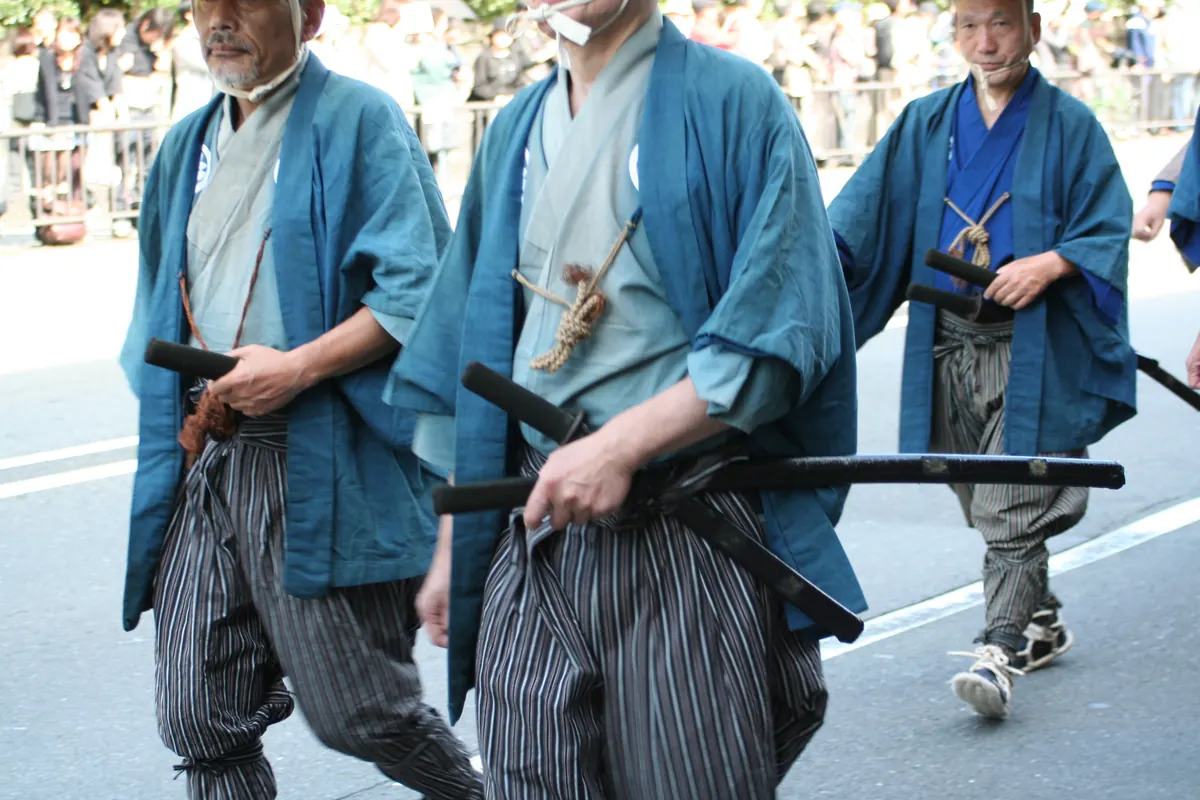
Kenbu performers wear a kimono with a hakama over it, and the theatre describes the kimono as crested. A hakama is a garment for the lower body, tied at the waist and falling about to the ankles, usually worn over a kimono. It comes in a divided form, like wide trousers, and an undivided skirt-like form. Hakama were introduced around the 6th century, and today they are worn in kendo and iaido as well as on formal occasions.
How a hakama is tied
Four straps, called himo, hold it in place: two longer ones at the front and two shorter ones at the back. Many have a stiff back panel, and a small spoon-shaped piece tucks behind the obi. Martial-arts hakama often have seven deep pleats, arranged asymmetrically in keeping with Japanese taste. Kenbu footwork uses a low, sliding step called suriashi, and a forceful foot-stamp marks moments of power.
The small extras
Kenbu is danced in tabi, the divided-toe socks, and optional items include a hachimaki headband to hold back the hair and tasuki cords to tie up the sleeves. When those are worn, a white cloth belt is traditionally tied over the hakama. It began with samurai preparing for battle, when it reinforced the hakama ties so the garment would not fall down if the ties were cut.
- Tabi: divided-toe socks
- Hachimaki: a headband
- Tasuki: cords that tie the sleeves back
- White belt: worn over the hakama ties
The sword
The sword in kenbu is a katana, drawn from its scabbard and returned to it as part of the performance. Many of the sheathing, unsheathing and striking rules come from iaido, a martial art that practises drawing, cutting and sheathing in solo drills. Kenbu's emphasis is different: its postures are made to look showy for an audience, so they can differ from the martial version even when the pattern name matches. After the performance, you are given the chance to hold a sword yourself and swing it under the instructor's command. The katana itself is a curved, single-edged sword with a guard and a long grip for two hands, and it appeared later than the tachi, in the Muromachi period.
The sword as a stage prop
Kenbu uses a trick of the imagination called mitate, where one object stands for another. A sword can become a cane, a bow or even a gun. Some pieces also use older sword types, such as the tachi, and the theatre says choreographies often bring out those features. So the same katana can play several parts in a single piece, which is why the dance reads as storytelling and not as a drill.
Hakama beyond the stage
Hakama are not only a performer's garment. Men wear them on formal occasions such as tea ceremonies, weddings and funerals, and Shinto priests wear them every day. Women mostly wear them at graduation ceremonies. In the Meiji and Taishō periods a reformer promoted hakama for girls' schools, and they became standard high-school wear. Very long versions called naga-bakama appear in Noh, kabuki and Shinto rituals. So a hakama carries ceremony as well as martial associations, and that is part of why kenbu looks dignified.
The folding fan
The fan is the second prop, and in many ways the more flexible one. The theatre says the performers use it to imitate falling petals. In mitate, a fan can stand for plants, rain, wind, mountains, waves, a door, a helmet or armour. In the lesson, if time allows, you may learn how to use the fan too.
A different hat for fan dance
In shibu, the fan dance, the performers are also dressed in hakama and kimono, though some wear longer kimono instead. A few performances use steeply pointed straw hats that hide the faces of the dancers. Postwar, when swords were banned for about seven years, schools substituted fans for swords, and the fan version stayed even after swords were legal again. That history is one reason fans are so common in kenshibu today.
Sources