The art form
What is kenbu? Sword dance and samurai poetry
Kenbu is a Japanese stage dance of sword, fan and chanted poetry. Here is where it comes from, how a piece is built and what to look for in the show.
Book the kenbu show ↗Quick answer
Kenbu is a Japanese stage dance in which a performer moves with a sword and a folding fan while a reciter chants a poem, often a short classical Chinese one written by a samurai. It is a performing art, not a fight and not a martial-arts class. Its sword handling borrows from sword-drawing arts such as iaido, but the aim is expression. The modern stage form took shape after 1868, once samurai had lost their swords.
A dance, not a fight
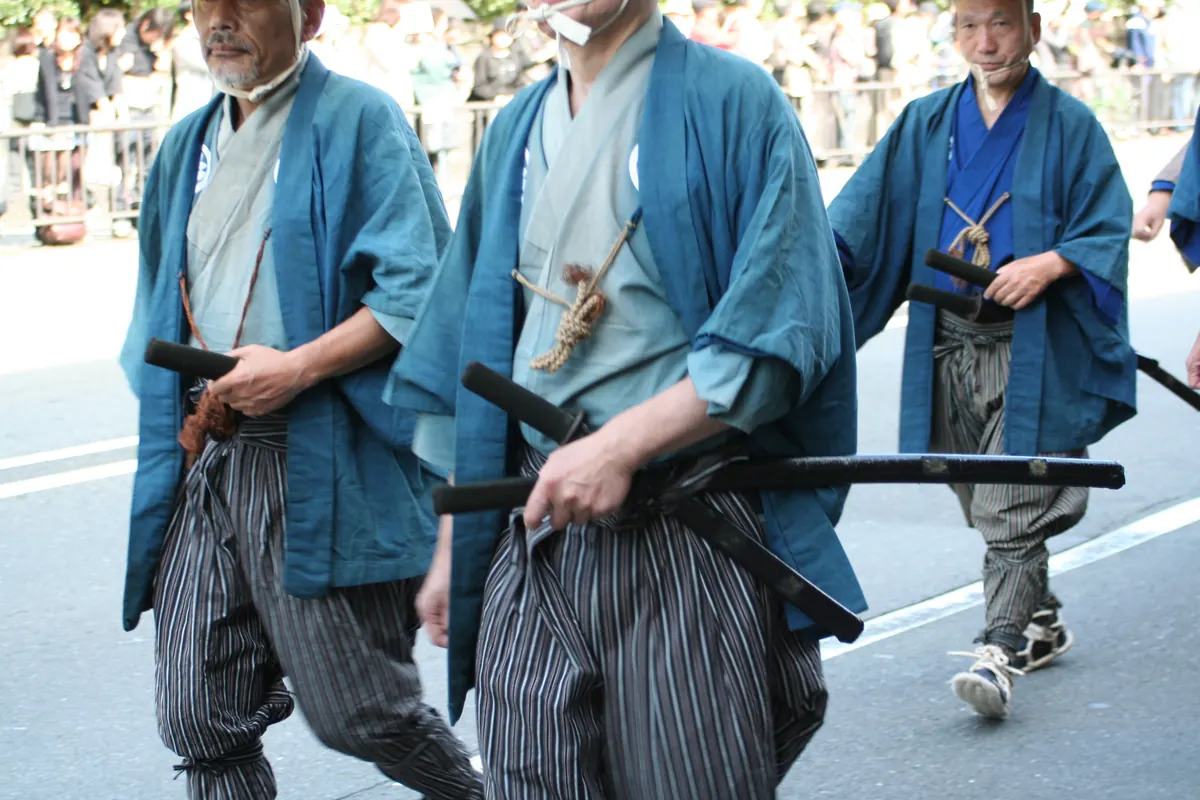
Kenbu means sword dance, and the first thing to know is that it is theatre. A performer draws, cuts and sheathes a katana, but nobody is fighting anyone, and nothing is scored or won. The movements are chosen to look clear and strong from the back of a room. Its own practitioners describe it as a stage art that grew out of martial training, which is a different thing from a martial art. The sword stays in your mind as a character, not as a weapon, and the poem tells you which character it is. The theatre says the first performers were political figures of the Bakumatsu period, the last years of the shogunate, who used kenbu for meditation, for morale and to express their resolve.
Sword, fan and poem
The wider family is called kenshibu, roughly sword and poetry dancing. Kenbu is the branch that uses a sword. Shibu, also called senbu, is the fan dance, with poetry that is generally less warlike. Some kenbu pieces also use a fan, and the classical basic style, called ginkenshibu, needs only three things: a reciter's voice, a sword and a fan. Everything else, from music to lighting, is a later addition. That simplicity is why a show can work in a small room with no set at all. Sword dances go back as far as the Nara and Heian periods, but the modern form of kenshibu is treated as a development after 1868, the first year of the Meiji era.
- Kenbu: sword dance
- Shibu or senbu: fan dance
- Ginkenshibu: the classical form, voice, sword and fan
The poem comes first
The poem chanted in kenbu is called shigin, and the chanting itself is ginei. The reciter, the ginshi, stands at the side of the stage, and the dancer, the maishi, performs in the centre. The dancer shouts a signal, the chanting begins, and the movement follows the meaning of the verse. Chinese poems are the most common, especially short four-line forms, though Japanese waka and haiku are also used. The reciter's voice sets the pace of the whole piece, and the sword answers it. Today's mainstream style often adds a koto or shakuhachi, in the order overture, song and postlude, with the dancer entering on the overture, while recorded orchestral music became common after the war.
Read next: Shigin: the chanted poetry behind kenbu
How a piece is built
A typical programme lasts about three to five minutes, and it usually needs no sets or props. Choreographers combine established patterns, and a performer may invent a new one. The patterns fall into three groups: sword actions for fights, expressions of character and emotion, and mitate, the art of making one object stand for another. The footwork is a low, sliding step called suriashi, and a forceful foot-stamp, so hard it makes a loud noise, expresses power. Knowing more patterns makes any piece easier to read. Moving across the stage is called hakobu, not walking, and it comes in a firm, low martial version and a more upright, dance-like one.
- A sword can stand for a cane, a bow or a gun
- A fan can stand for rain, wind, a wave, a door or a helmet
- A stamp of the foot signals force
Where the forms come from
The patterns are called kata, and the theatre traces them to the Sengoku period, when commanders showed off their power with elaborate armour and bold displays on the battlefield. Those displays of bravery became the basis for kenbu's forms. Samurai governments ruled Japan for about seven centuries, starting with the Kamakura shogunate in the 12th century. The word samurai itself comes from a verb meaning to serve, and the earliest samurai guarded aristocrats. The art is younger than that long history, but its vocabulary borrows from all of it. Samurai wore the katana edge up, thrust through the sash, so that a single motion could draw and strike, and the older tachi hung from the belt edge down. Some kenbu choreography still emphasises that older sword.
A piece from the repertoire
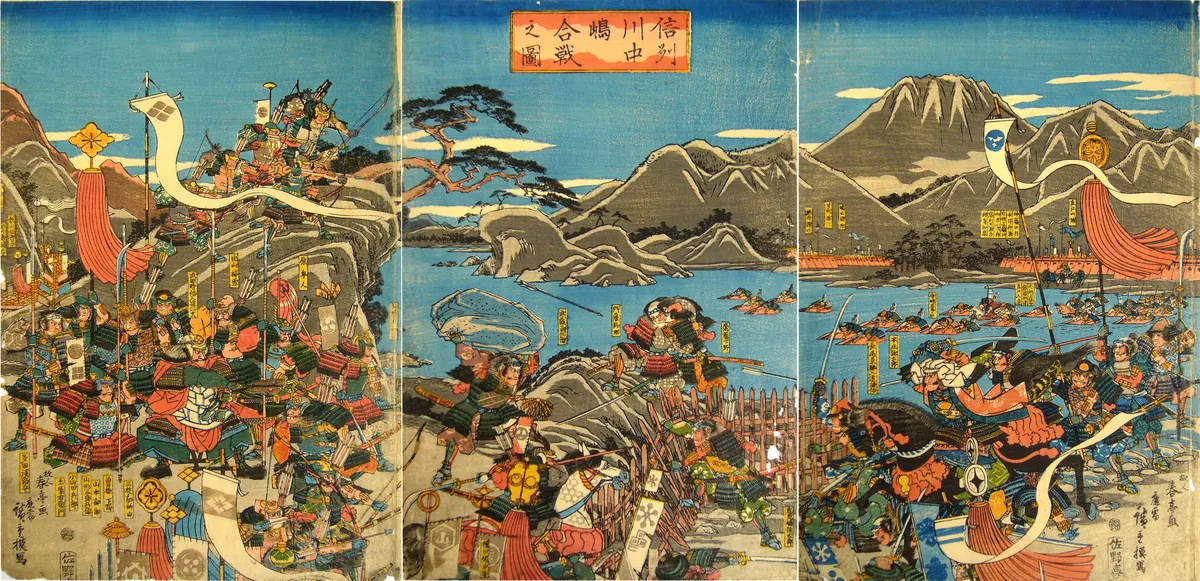
One well-known piece takes its poem from Rai San'yō, a samurai-born scholar who lived from 1780 to 1832 and died in Kyoto. His verse describes the rivalry between the warlords Uesugi Kenshin and Takeda Shingen in the Sengoku era, told from Uesugi's point of view. The battles, fought between 1553 and 1564 on the Kawanakajima plain, are popularly known by that name, and in the best-known account of the 1561 clash Shingen parries Kenshin's blow with his signalling fan. Knowing the poet and the story helps with the choreography, so the theatre suggests reading about a poem before you watch it.
How it became a stage art
After Commodore Perry's ships arrived in 1853, samurai debated Japan's future and some put their thoughts into Chinese-style poems, reciting them while they danced with sword and fan. Then the old order collapsed. In 1867 political power was handed back to the emperor at Nijō Castle in Kyoto, which the theatre's essay marks as the end of the samurai age. Commoners were barred from wearing swords in 1870, and an 1876 edict banned carrying them in public for almost everyone. Master swordsmen began staging fencing shows in the early 1870s, and kenbu spread across Japan. The theatre's history essay dates kenbu as a traditional performing art from a Tokyo school founded in 1890.
Swords, bans and fans
Kenbu has had to survive a second ban. After the Second World War, owning swords was outlawed in Japan for about seven years, and kenbu schools switched to fans. When swords became legal again, the fan version stayed, and shibu later grew into a style distinct from kenbu. Today there are more than a hundred kenbu schools in Japan, and the Kyoto theatre says its instructors hold diplomas from one of them. It was founded in 2014 by the successor of one such school, so the lineage behind the dancers is a living one. Modern kenshibu itself traces back to a touring fencing company founded in 1872, though many later schools have other origins.
What the dancers wear
Kenbu is performed in kimono and hakama, and the theatre describes its kimono as crested. Optional extras include a headband, sleeve ties and a white belt over the hakama ties, and the dancers wear tabi, the divided-toe socks. The costume keeps the sword and fan clear and the movement visible, and it links the performance to the samurai dress it recalls. Hakama arrived in Japan around the sixth century and are worn in kendo and iaido too, which is why they look at home beside a sword. The guide to kenbu costume goes through each piece, and why a hakama is built the way it is.
Read next: Kenbu costume: kimono, hakama, sword and fan
What to look for in the show
The Kyoto performance shows both traditional and new-style kenbu, plus fan technique, with an English introduction. Watch the reciter's voice as much as the sword: the poem sets the pace. Look for mitate, where a swing of the fan is a wave or a door. Notice the sliding walk and the sudden stamp. Pieces are short, so if a poem passes too quickly to follow, watch the fan and the feet, which carry the same story. Then, in the short lesson, notice how hard it is to stop a cut cleanly. That control, more than speed, is what the dancers are showing you.
Read next: Samurai kenbu in Kyoto: choose and book
Who this isn't for
Kenbu is not for anyone hoping for a duel or a fast-paced action show. The pieces are short, the poems are in Japanese, and the effect depends on stillness and control. If you want a sword fight, look at a kendo class instead. If you would like spectacle with a beat, the taiko drum show near Kawaramachi is closer to what you are imagining. And if you need to film what you see, this show does not allow photography during the performance.
Frequently asked questions
Is kenbu a martial art?
No. Kenbu is a performing art. Its sword rules for drawing, cutting and sheathing borrow from sword-drawing arts such as iaido, but it emphasises showiness and expression, and nobody spars or competes.
What is the difference between kenbu and shibu?
Kenbu is the sword dance and shibu, or senbu, is the fan dance. Shibu's poetry is generally less martial. Together they are called kenshibu.
What language are the poems in?
Many are classical Chinese poems chanted in Japanese, with some Japanese waka and haiku. The reciter performs, often from memory, while the dancer interprets the meaning in movement.
How long is a kenbu piece?
A programme usually runs about three to five minutes, and some are shorter. A show strings several pieces together, so expect a series of short dances, not one long one.
Do I need to know Japanese to enjoy it?
No. The Kyoto show is narrated in English, and the movement tells the story. Reading about the poem beforehand, if you want to, deepens it.
Is iaido the same thing?
No. Iaido is a martial art practised in solo drills against imaginary opponents, with no sparring. Kenbu borrows some of its sword handling, but its goal is performance.
Sources
- About the art of kenbu (Samurai Kenbu Theater)
- Kenbu essay: origins and how a piece is built (Samurai Kenbu Theater)
- Kenbu essay: how to watch a performance (Samurai Kenbu Theater)
- Kenbu essay: kenbu and the samurai (Samurai Kenbu Theater)
- Battles of Kawanakajima (Wikipedia)
- Haitorei, the sword abolishment edict (Wikipedia)
- Kenshibu (Wikipedia)